table of contents
1. What you realize when you search for "I want to be a keyboard player"
If you search for "how to become a keyboard player," you'll notice something surprising. While there are plenty of articles explaining how bands can recruit keyboardists, there are almost no articles written from the perspective of someone who wants to become a keyboard player themselves. I myself was surprised by this bias when I reviewed existing information for this article.
Our blog has previously published articles on the difficulties of recruiting and finding keyboardists , as well as a complete guide on how to find a keyboardist . However, these articles have all been written from the perspective of "how a band finds a keyboardist." This article, however, is written from the other side—from your own perspective: "I want to start playing keyboards and be able to play in a band." I believe that information about keyboards and bands only becomes complete when both articles from the recruiting side and articles from the aspiring side are included.
This article will provide a roadmap for those starting to learn keyboard on their own, and explain, as concretely as possible, how to determine "at what level you can play in a band." Whether you have piano experience or are a complete beginner, the ultimate goal is the same: to be able to create your own sound within the living music of a band.
The search intent of "How to become a [instrument name] player" isn't limited to keyboards. While there are articles from the perspective of "the band looking for a player" for other instruments like drums, bass, and vocals, there are surprisingly few articles from the perspective of "the person who wants to become a player." This article is the first in a series, focusing specifically on keyboards. Those facing similar challenges with other instruments will likely find insights into the "difficulty of finding a player" in articles about drummers or bassists . Try reading this while keeping in mind which position you currently find yourself in.
Membo , the service we operate, allows you to search across multiple Japanese band member recruitment websites. When you look at the recruitment conditions posted there, you'll notice a surprisingly large number of entries that say "Keyboard experience welcome" or "Chord playing is also acceptable." In other words, once you've followed the roadmap outlined in this article, there are far more entry points available to you than you might imagine.
2. Why are there so many people with piano experience, yet so few who can play in a band?
According to the Ministry of Internal Affairs and Communications' 2021 Survey on Time Use and Leisure Activities , 10.2% of Japanese people aged 10 and over play musical instruments (participation rate), amounting to approximately 11.4 million people. This naturally includes many people who play piano, electronic piano, or keyboard. Furthermore, a survey conducted by Cross Marketing in 2024 found that 54.1% of men and women aged 20-69 have experience playing musical instruments, with "piano (including electronic piano)" being the most common instrument at 31.7%. People who have taken piano lessons at music schools such as Yamaha and Kawai are by no means uncommon in Japan.
First, let's clarify some terms. In this article, "pianist" primarily refers to a performer who accurately reproduces sheet music and completes a piece of music alone, either as a soloist or accompanist. On the other hand, a "keyboardist" (a keyboard player in a band) is a performer who, in relation to other parts such as drums, bass, guitar, and vocals, selects notes in accordance with the chord progression and rhythm, and sometimes improvises and arranges, playing a supporting role for the entire ensemble. Although both have the same foundation of keyboard playing skills, the required abilities are completely different.
Nevertheless, when you actually try to find a keyboardist for a band, it's surprisingly difficult—this is something the Membo editorial team has repeatedly heard from people working in the field of recruitment, and we've covered it in detail in our article on the difficulties and methods of finding keyboardists. While there are no official statistics yet that directly compare the percentage of people with piano experience with the success rate of keyboardist recruitment, given the large number of people with piano experience and the high frequency of "keyboardist wanted" postings, it's easy to imagine that there's a significant gap between the two. The reason is simple: there's a much bigger gap than you might imagine between "playing according to the sheet music" and "playing freely within a band."
The performance skills cultivated through classical lessons excel at accurately reproducing sheet music. However, what's required in a band are slightly different abilities. The ability to assemble backing patterns on the spot when given only a chord progression. The ability to create groove in time with the drum rhythm. The ability to support the entire piece of music even when the vocals or guitar falter. This transition to "playing without sheet music" is the first hurdle for many experienced pianists. Conversely, if you understand the nature of this hurdle, you can steadily overcome it even through self-study. The roadmap introduced in the latter half of this article is precisely a map for overcoming that hurdle.
Five common stumbling blocks for experienced pianists
- Unfamiliar with chord notation : While proficient with standard musical notation, I get stuck when given only chord names like C, Am, and G7.
- Inability to improvise arrangements : Even with extensive training in playing according to sheet music, lacking experience in "freely choosing notes within a defined framework," they become hesitant when faced with a blank chord progression.
- My hands are stuck in a "main melody and the rest of the band" relationship : I'm so accustomed to the classical division of roles—right hand for melody, left hand for accompaniment—that I feel uncomfortable supporting the same chord with both hands.
- The habit of "playing too much" is hard to break : You want to cram in as many notes as you've practiced, but in a band setting, you need to change your perspective and realize that "reducing rests and the number of notes" is itself a skill.
- Lack of a sense of balance in volume and tone : When accustomed to playing with just a piano, one tends to lack experience in being aware of how their own sound sounds within the sound pressure of drums and guitars.
These are by no means weaknesses. Rather, because you have the fundamental skills acquired through classical training, these are obstacles that can be easily overcome if you practice in the correct order. The following self-study roadmap is structured to address each of these five stumbling blocks one by one.
3. Understand the differences between keyboards, synthesizers, digital pianos, and electronic organs.
Before you start learning on your own, the first thing you need to understand is the differences between the instruments themselves. Even though we refer to them collectively as "keyboards," there are actually several instruments with very different characteristics.
| musical instrument | Features | Main role in the band |
|---|---|---|
| Acoustic piano | A live instrument that produces sound by striking strings with a hammer. It offers a high degree of expressiveness through touch. | The main character of ballads and piano rock |
| Digital piano | An electronic instrument specifically designed to replicate the feel of a piano. The keyboard touch is very close to that of a real piano. | Widely used as a substitute for piano parts. |
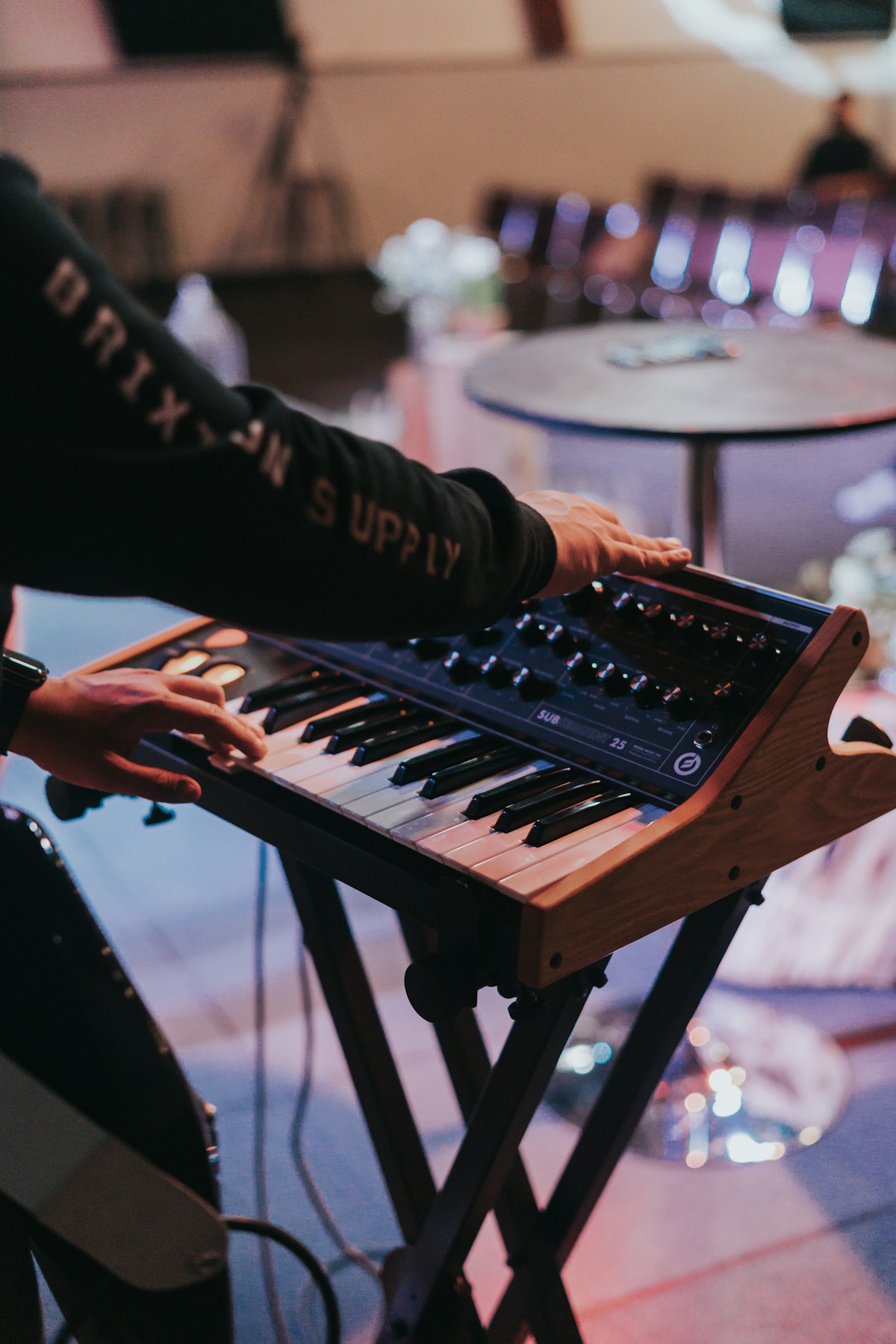
| synthesizer | A keyboard instrument that allows you to adjust and synthesize your own timbres. | Lead, pad, sound effect-like phrases |
| Keyboard (in the narrow sense) | A musical instrument that uses a keyboard to control pre-recorded sound sources. A light touch is generally preferred. | All-around use with multiple tones to switch between. |
According to Yamaha's explanation, what is generally called a keyboard refers to an instrument that manipulates pre-prepared sound sources using a keyboard, and the ability to freely adjust and synthesize timbres is the key difference between a keyboard in the narrow sense and a synthesizer . A synthesizer is described as "an instrument that synthesizes musical sounds mainly using electronic engineering methods," and its development is not the result of a single invention but the product of a gradual evolution over more than 100 years. The basic elements were established in the 1930s, modular synthesizers appeared in the 1960s, and digital instruments rapidly became popular from the 1970s onward.
The Electone, known as a keyboard instrument unique to Japan, is also an interesting instrument. Since its introduction in 1974, it has incorporated analog synthesizer sound sources, and while its appearance is that of a multi-key Electone, its internal sound source has moved closer to that of a synthesizer. However, the essence of the Electone lies in "real-time performance that allows for improvisation," and it continues to maintain its unique playing style. When you're just starting out in a band, you don't need to perfectly understand these differences. The most important thing is to start practicing with the instrument you have on hand, while imagining "what kind of sound you want to make."
4. Self-Study Roadmap Step 1: Learn to Read Codenames

When learning the keyboard on your own, the first hurdle is learning to read chord names. Even if you can't read sheet music completely, if you understand chord names (such as C, Am, F, G7), you can handle most situations in a band setting. Band scores and sheet music for singing and playing usually include chord names, so starting there is the quickest route to success.
The following order is recommended for a specific procedure:
- Learn the shapes of major and minor chords : First, memorize the basic forms of C, D, E, F, G, A, and B, and how to play each minor chord.
- Memorize common four-chord patterns as a set : Learning standard chord progressions like C→G→Am→F (the so-called classic progression) as a whole will give you a sense of being able to "play" faster than memorizing chords individually.
- Understanding diatonic chords : Knowing the sequence of seven chords naturally used within a single key allows you to predict which chord will come next.
- Introduction to seventh chords and fractional chords : Gradually become familiar with notations like G7 and C/E, which frequently appear in pop and rock music.
- Practice dividing the chords between your right and left hands using simple song chord charts : Start with a simple form where your left hand plays the root note and your right hand plays the chord.
The estimated practice period is approximately 1 to 2 months if you consistently practice for about 20 to 30 minutes a day. Of course, there are individual differences, but once the "basic major and minor chord patterns" and the "standard chord progressions" become familiar to your fingers, you can consider Step 1 a signal that you are ready to move on to the next stage.
At this stage, there's absolutely no need to try difficult songs. Choose songs with simple chord progressions, like those introduced in the guide on how to choose easy songs for your first band practice , and prioritize getting used to the feeling of "looking at chords and instantly translating them into keyboard shapes."
5. Self-Study Roadmap Step 2 | Independently move both hands and maintain rhythm
Once you can read chords, the next hurdles are "moving both hands independently" and "keeping the rhythm." In classical piano lessons, the basic roles are that the right hand plays the melody and the left hand plays the accompaniment, but in a band setting, keyboardists need the ability to support chords with both hands while keeping up with the rhythm played by the drums and bass.
A recommended practice method is to use a metronome or rhythm machine app to practice playing chords at a consistent tempo. It's fine to start at a slow tempo. Gradually increasing the variations—playing chords in eighth notes, arpeggios in sixteenth notes, and consciously creating "silent parts" by incorporating rests—will help you develop a playing style that doesn't get lost in the band sound, but also doesn't overpower it.
Achieving independence with both hands requires some repetition, but there's no need to rush. As a guideline, after completing Step 1, you should continue practicing for another 1-2 months until you can play chords without your tempo wavering. As introduced in the first band practice roadmap , it's perfectly fine to gradually improve your level of proficiency in line with the band's overall practice schedule. What's more important is not to "join a band only after you can play perfectly," but rather to "join actual band practices once you can play to a certain extent and refine your skills there."
6. Self-Study Roadmap Step 3 | Developing Ear Training and Session Handling Skills
Once you can read chords and your hands can move independently, the final big step towards reaching a "band-ready level" is strengthening your ability to transcribe music by ear and handle jam sessions. The ability to listen to a song, understand the key and chord progression, and build an accompaniment on the spot, even when sheet music or chord charts are not available, is extremely valuable in band activities.
When practicing transcribing music by ear, you don't need to jump straight into difficult songs. It's more realistic to start with short sections, such as just the chorus or one verse of a song you like, and gradually expand the scope. Step 3 is a training method without a clear finish line, but as a guideline, if you continue for another 3 to 6 months after completing Step 2, you'll often feel confident enough to keep up without falling too far behind in jam sessions with people you've just met. As mentioned in the Jam Session Beginner's Guide , in jam sessions, situations frequently arise where you have to "guess the chords and play along even if you don't know the song." This kind of improvisational ability has its limits with self-study alone, so if possible, it's recommended to visit jam bars or open mic events as early as possible. The experience of actually playing music with other instrumentalists will give you insights that you can't get from self-study. If you can't find jamming partners, you can try searching for bands that welcome one-off jam sessions on Membo .
7. How to choose a practice environment and equipment | Keyboard, DAW, and practice apps
When continuing to learn on your own, the practice environment and equipment selection are also important factors. When choosing your first instrument, you should keep three things in mind: "Does it suit your touch preference?", "Is it easy to carry?", and "Does it have a full range of sounds for band practice?". As a general guideline for price ranges, entry-level keyboards with around 61 keys and touch response functions are generally in the 20,000 to 40,000 yen range, mid-range models with more sounds and touch reproduction are in the 50,000 to 100,000 yen range, and high-end models intended for stage use are generally in the 100,000 yen range or more (there is a wide range depending on the manufacturer and model). Those who want to be particular about piano touch should choose an electronic piano, while those who want to use multiple sounds by switching between them should choose a keyboard or synthesizer. There is no need to buy expensive models from the start; it is more realistic to start with an affordable instrument to build a foundation and then upgrade your equipment once your role in the band becomes clear.
In recent years, more and more people are using music production software called DAWs (Digital Audio Workstations) to practice composing and programming at home. Using a DAW allows you to record your own playing and listen to it objectively, or practice along with drum and bass tracks, making it possible to train your "sense of ensemble" even on days when you don't have band practice. Even if you have difficulty finding the time or money to attend music lessons, self-study methods are not limited to DAWs and apps. There are many performance channels on YouTube that explain everything from the basics of playing chords to how to put together band arrangements, and instructional books titled "Chord Playing" or "Popular Piano" found in bookstores are standard self-study materials that systematically organize how to hold the keys and accompaniment patterns. By combining videos, instructional books, and apps according to your level of understanding, you can increase the intensity of your self-study while keeping costs down.
Comparison of practice apps for self-studying keyboard and piano
Practice apps for smartphones and tablets are convenient tools that compensate for the weaknesses of self-study, offering features such as visualization of chord progressions and real-time evaluation of fingerings. A comparison of the trends of some representative apps is as follows (pricing plans may change, so always check the official website for the latest information before using).
| app | Features | Price trends | Suitable people |
|---|---|---|---|
| Simply Piano | This beginner-friendly app uses voice recognition to analyze the notes you play in real time, making it easy to keep playing. | Primarily annual plans. Relatively affordable when calculated on a monthly basis. | For complete beginners who want to get into the habit of touching the keyboard. |
| flowy | You can progress at your own pace with lessons supervised by professionals. There is a wide repertoire of songs. | Multiple plans are available, including individual and family plans. Annual contracts tend to be slightly cheaper. | For those who already have some basic knowledge, or who want to start practicing with their favorite songs. |
| Yousician | It features high gamification and supports multiple instruments. Progress is visualized. | Subscription-based service. Additional charges may apply to unlock popular songs. | For those who want to continue practicing in a game-like way, and for those who want to practice other parts at the same time. |
While these apps are excellent at increasing keyboard time and developing basic chord fingering and sight-reading skills, they don't teach you the nuances of playing rhythm in a band or listening to other parts while playing. Think of apps as merely tools to improve the efficiency of basic practice, and once you feel you've made some progress, it's best to quickly transition into jam sessions or actual band practice. Ultimately, the skills needed to succeed in a band can only be honed through experience playing with real people. Focus on creating opportunities to actually play, just as much as you do on investing in equipment and apps.
8. Learn from world-renowned keyboardists in Japan.

When you get lost while continuing to learn on your own, the paths of keyboardists who have actually been active in bands can be a great source of inspiration. Here, we introduce some real-life performers whose careers can be verified.
In Japan, one prime example is Yuko Hara, the keyboardist for Southern All Stars . During her university years, she was recruited into a music club that Keisuke Kuwata and others belonged to, due to her exceptional playing skills. Since their major debut in 1978, she has contributed to the arrangement of numerous songs. Kuwata has described her as "Southern All Stars' compass," and she continues to be a cornerstone of the band's sound. Another example is Minoru Mukaiya, known as the keyboardist for the fusion band CASIOPEA . In 1977, at the age of 20, he joined the amateur band CASIOPEA and, together with leader Issei Noro, established a virtuosic and acrobatic playing style. In the field of techno-pop, Ryuichi Sakamoto, who played synthesizers as a member of Yellow Magic Orchestra (YMO) , is also an indispensable figure. With a classical background from studying piano and composition since childhood, his playing style, which fuses pop and classical music using sequencers, greatly expanded the possibilities of band keyboards in Japan.
Looking overseas, Ray Manzarek of The Doors formed the band with Jim Morrison in 1965 and defined the band's musical style with a unique keyboard sound utilizing a Vox Continental combo organ. In the world of hard rock, Jon Lord of Deep Purple made the Hammond organ a presence comparable to the guitar by plugging it directly into a Marshall amplifier, elevating the keyboard to a leading instrument in rock bands. And in the field of progressive rock, Keith Emerson of Emerson, Lake & Palmer became one of the first artists to tour the world with a Moog synthesizer, establishing the synthesizer as a means of expression in rock. What they all have in common is that they did not remain within the existing "way of playing the piano," but instead independently pioneered the role of their instrument within the band structure.
9. 7 Checklist Items to Determine Your "Band-Ready Level"
Many people who continue to learn on their own worry whether they are ready to join a band. There is absolutely no need to aim for perfection, but try using the following seven items as a checklist as a guideline.
- Can you put together an accompaniment on the spot, given only a chord chart?
- Can you maintain a steady tempo in time with the drum rhythm without a metronome?
- Can you decide for yourself when to play and when to rest within a song?
- Can you roughly guess the chord progression of a song just by listening to the chorus of your favorite song?
- Can they continue to support the overall music without panicking, even if the vocals or guitar playing falter a little?
- Can you communicate your requests regarding volume balance and PA system requirements in concise language?
- Can we create a song in a rehearsal format after just a few sessions, even with members we've just met?
You don't need to meet all the requirements. In fact, these are skills you can develop after joining a band. By referring to the guide on how to rent a practice studio and gaining experience playing with a band in a studio, you will naturally acquire many of these skills. What's important is not waiting until you can play perfectly, but having the courage to take the plunge once you can do about half of the seven requirements.
I've spoken to many band members, and I've found that most bands waiting for a keyboardist aren't looking for someone with exceptional technical skills from the start. What I've heard far more often is, "We just need someone who can follow the chord progressions," or "We want someone who can add color to the sound, including visual appeal during live performances." This 7-item checklist isn't meant to measure perfection, but rather to serve as a map to help you understand where you stand right now.
10. Taking a step beyond self-study | Joining a studio session band
Once you've completed a certain portion of the roadmap, it's time to dive into the real world. While renting a practice studio and continuing to practice the basics alone is a good method, if you want to acquire the skills needed to succeed in a band as quickly as possible, participating in actual band practices and jam sessions is the most direct route.
For those who are anxious about joining a band for the first time and want to know how to proceed, our guide for beginners to join a band explains everything in detail. If you are joining an existing band midway through, please refer to our guide on how to write a self-introduction statement and explain specifically what kind of practice you have done and what kind of songs you can play, which will put the band at ease. If you want to form a band from scratch, we recommend starting with our guide on how to start a cover band and gradually working your way up to creating original songs .
If you're struggling to write a self-introduction as a keyboard player, the following approach might be helpful.
- For a self-taught beginner : "I have X years of piano experience and am practicing chord playing and band accompaniment on my own. I can put together accompaniments for pop and rock songs if I have a chord chart. I can only transcribe short phrases by ear so far, but I want to keep practicing and expand my capabilities."
- For those with piano experience who are in the transition phase : "I have several years of experience playing classical piano, and I am currently self-studying chord playing and ear training in preparation for band performances. I continue to practice keeping rhythm while supporting chords with both hands, and I can read chord charts to some extent. I would love to participate, even if it's just for practice once or twice a month."
Rather than listing your perfect playing skills, being honest about "what level you're at now and how often you can practice" will be more reassuring for the band.
Keyboards, along with drums, bass, and vocals, are one of the parts that bands often lack. When you read about how to find drummers , bassists, or vocalists , you'll see that the same "searching" struggles exist for other parts as well. In other words, if you can play the keyboard, you are a rare and sought-after member by many bands. Using a band member recruitment service like Membo , you can search for bands that match your skill level and desired musical style on a nationwide scale. If you can't find a suitable band in your local area, expanding your search area is also an effective strategy. For those exploring the path of "joining a band" from other instruments such as violin or cello, guides for violin and string players should also be helpful in terms of their approach.
11. How foreign keyboardists can enter the Japanese band scene
It's not uncommon for foreign musicians who can play keyboards to join Japanese bands. However, they often encounter difficulties with differences in chord notation and communication in Japanese. This article introduces practical tips for finding band members, overcoming language barriers when foreigners and Japanese people form a band . For foreign musicians who want to start a band while living in Japan, please also refer to the Complete Guide to Forming a Band in Japan (Practical Edition for Foreign Musicians) .
Membo 's commitment to supporting eive languages stems from its desire to lower these language barriers as much as possible. Even if you're not familiar with Japanese chord notation or band terminology, being able to check recruitment information in your native language and start communicating using translated text significantly lowers the barrier to participating in the Japanese band scene. No matter where you live in Japan, using Membo , which supports all 47 prefectures , expands your chances of finding bands looking for keyboardists. If you want to learn more about the Japanese music scene itself, you can also refer to our "Introduction to the Japanese Music Scene" and "What is the Music Scene? A Complete Guide to the Japanese Band Scene Map and How to Get In ."
12. Summary | From "playing" to "making music together"
This article directly addresses the search intent of "How to become a keyboard player," introducing a self-study roadmap—three steps: reading chords, developing independent hand control, and honing ear training and session-playing skills—along with a seven-item checklist to determine if you're at a level where you can play in a band. We also looked at the paths of real-life keyboardists such as Yuko Hara, Minoru Mukaiya, Ryuichi Sakamoto, Ray Manzarek, Jon Lord, and Keith Emerson. They, too, started from the stage of simply being able to "play," and honed their sound within the context of a band.
While many people have piano experience, few can play in a band—the gap mentioned at the beginning of this article is, conversely, a great opportunity. By learning to read chords, keeping rhythm, and gradually honing your ear-copying and jamming skills, you can become an indispensable member of many bands. From the goal of "being able to play" to the goal of "being able to play together." When you're ready to take that first step, try searching for bands looking for a keyboardist on Membo . If you have any problems, be sure to check out Membo's help page , Membo user guide , app usage page , Membo announcements page , and author information page.
- Search across more than 10 Japanese websites at once
- Automatic translation into 5 languages
- Coverage for all 47 prefectures
- Free to use