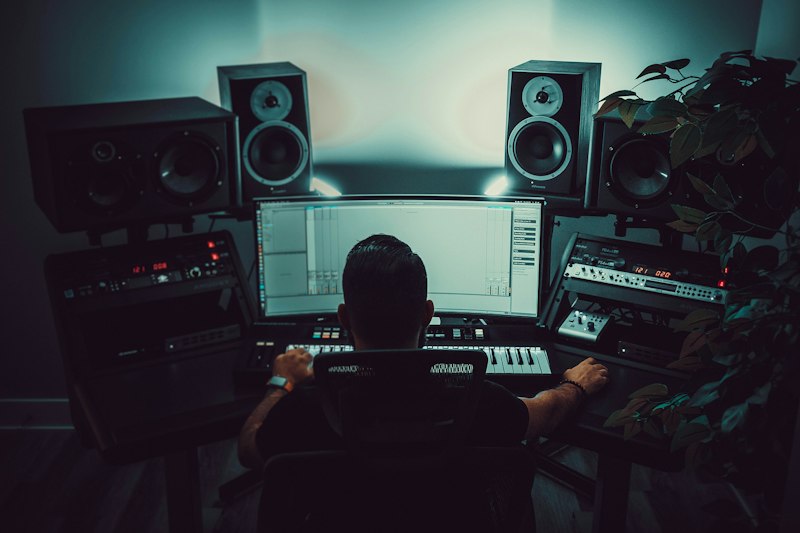
After honing your skills with cover bands, the desire to tackle original songs naturally emerges.
While the joy of recreating your favorite songs is unparalleled, the urge to create "your own unique sound" develops naturally over time as a band. In fact, once members have improved their skills through learning how to start a cover band, the next goal becomes performing original compositions live.
However, many people hesitate to take that first step due to concerns like "I've never composed before" or "I don't understand music theory." This article provides concrete guidance on how to create original songs even with zero composition experience, from choosing the right approach through band arrangement to sharing demo recordings.
Band Composition Defined — Three Key Differences from Solo Composition
Let's first clarify the definition. Composition is the act of combining three elements—melody, chord, and rhythm—to create a new piece of music. Whether you're adding accompaniment to a hummed tune on piano or guitar, or arranging loops in a DAW, the fundamental activity remains the same.
But what makes band composition different from solo composition? There are three major differences.
| Aspect | Solo Composition | Band Composition |
|---|---|---|
| Process to Completion | Completed within one person's mind. Inspiration-driven | Collaborative work: one person creates the framework, then members add detail |
| Arrangement Freedom | Anything is possible if programmed in a DAW | Adjustments needed based on each member's skill level and preferences |
| Post-Completion Strength | Complete once recorded | Can be transformed through live performance; deepened by member ideas |
The magic of band composition lies in "the framework you created being transformed into something beyond your expectations through your members' hands." It's not uncommon for the initial demo to be completely different from the finished product—something you can't experience in solo composition.
Conversely, since you're composing as a band, you don't need to aim for perfection from the start. Once you have the framework (melody and chord progression), you can develop it further while making music together. The three approaches we'll explain are all variations on "how to create a framework."
Three Approaches to Creating Original Songs
There are three main approaches to composition. There's no single right answer—choose based on your band members' strengths and your band's style.
| Approach | Overview | Best for Which Bands | Difficulty |
|---|---|---|---|
| Melody-First | Build the song from a hummed or vocal melody | Bands where the vocalist leads composition; song-oriented bands | ★★☆☆☆ |
| Chord-First | Determine the chord progression first, then layer melody on top | Bands centered on guitarist or keyboardist | ★★★☆☆ |
| Riff/Groove-First | Build from a guitar riff, bass line, or drum pattern | Rock/funk bands; those that grow songs from jamming | ★★★★☆ |
Melody-First — The Simplest Way to Start with Vocals
You can start by recording a hummed tune into your smartphone's recording app. Capture melodies that come to you during your commute or in the shower before they're forgotten. Even without knowledge of chords or instruments, if you can convey "the general feeling I'm going for" to your members, someone skilled at harmonies can create the arrangement.
One caution: humming alone can lead to unstable keys. If possible, add simple accompaniment on guitar or piano before sharing with your band—this makes communication with members much smoother.
Chord-First — The Classic Method That Harnesses Music Theory
Using the "standard chord progressions" explained later, first create a 4-8 bar chord progression. Then layer melody on top, similar to fingerstyle singing. Many J-POP and pop rock songs are created this way.
Someone familiar with chords plays guitar or keyboard while the vocalist adds melody, saying "something like this." Using the section practice method explained in How to Structure Band Practice, it's effective to lock in the chorus first, then add verses and pre-chorus sections afterward.
Riff/Groove-First — Growing Songs from Jamming
This method builds the song around a guitar riff or bass line. Iconic songs like Deep Purple's "Smoke on the Water" and The Rolling Stones' "(I Can't Get No) Satisfaction" were born from guitar riffs.
During studio jamming, develop ideas organically: "That riff is great" and "Let's match this rhythm to it." While this offers high creative freedom, sessions can easily become disorganized, so recording everything and extracting the best parts afterward is recommended.
Alternative Methods Beyond the Three Main Approaches — Options When You Hit a Wall
The three approaches above (melody-first, chord-first, riff-first) all involve "creating melody or chords from scratch." When you're exhausted by creating from nothing or ideas aren't flowing, these alternative methods are valuable.
| Alternative Method | Description | Best Used When |
|---|---|---|
| Emerging from Jam Sessions | Everyone freely makes music in the studio, record good phrases that emerge spontaneously, and assemble them | An extension of riff-first approach. For inspiration-driven bands |
| Reharmonizing Existing Songs | Practice by attaching different chord progressions to a favorite song's melody, then rewrite the melody to create an original | For intermediate musicians wanting to learn chord theory |
| Using Loop Samples as a Starting Point | Arrange loop materials from BandLab or Splice in a DAW, then layer live instruments on top | For bands wanting to try DTM-oriented composition |
| Using AI Composition Tools as a Draft | Generate templates using AI tools like Suno or Udio, use them for inspiration and structure reference (don't use as-is) | A modern composition method post-2024. For sparking ideas |
| Lyrics-First (Creating from Keywords) | Lock in your theme or lyrical phrases first, then compose melody and chords that fit | For bands that prioritize lyrical expression |
| Branching from Cover Songs | Practice a favorite song → change the arrangement → make it sound original → rewrite all parts to create a complete original | For beginners intimidated by starting completely from scratch |
All these methods are more approachable than "pure composition from zero." AI composition tools in particular have evolved rapidly since 2024, making them convenient for "shortening the template creation process." However, using an AI-generated song as-is raises copyright and originality concerns. Always use it as a "seed for ideas" and ultimately transform it with your own hands.
For more on creating songs from jam sessions, see How to Start Jam Sessions.
Chord Progression Basics — Master Five Standard Patterns
If you don't understand chord progressions, learning these five standard patterns is enough to start. The majority of J-POP, rock, and blues songs are made from these patterns or their variations.
| Name | Progression (Key=C) | Example Songs | Feeling |
|---|---|---|---|
| Canon Progression | C → G → Am → Em → F → C → F → G | Pachelbel's "Canon," used across classical to pop | Beautiful, grand, moving |
| Royal Road Progression (4536) | F → G → Em → Am | YOASOBI "Yoru ni Kakeru," Spitz "Cherry," and many others | Melancholic yet powerful |
| Komuro Progression | Am → F → G → C | Tetsuo Komuro productions, globe "DEPARTURES" | Driving, catchy |
| Just the Two of Us Progression | FM7 → E7 → Am7 → Gm7 → C7 | Grover Washington Jr. "Just the Two of Us," city pop broadly | Sophisticated, urban |
| 12-Bar Blues | C7×4 → F7×2 → C7×2 → G7 → F7 → C7 → G7 | Blues/rock generally, The Beatles "Birthday" | Raw, groovy |
For beginners, "Royal Road Progression" or "Canon Progression" are recommended. Both accommodate melody easily, and when used in a chorus, they naturally build excitement. Chord progressions themselves have no copyright, so using existing progressions poses no legal issues.
The basic method is to repeatedly play these progressions on guitar or keyboard while exploring melody with your voice. When something sounds "right," record it immediately. This repetition is the foundation of composition.
J-POP Chord Progression Usage Rates — Trends Visible in Hit Song Data
Music theory sites and song analysis reveal that J-POP hits concentrate on specific chord progressions. Summarizing analyses from Song-net, UtaTen, and various music theory resources reveals these patterns:
| Progression Name | Usage Trend in J-POP | Example Songs (Selection) |
|---|---|---|
| Royal Road Progression (F→G→Em→Am / IV-V-iii-vi) | Most common in choruses. Appears across ballads to rock | Spitz "Cherry," Mr.Children "HANABI," Official Hige Dandism "Pretender" |
| Canon Progression (C→G→Am→Em→F→C→F→G) | Standard for ballads and graduation songs. Stable development | Momoe Yamaguchi "Akikohade," Tatsuro Yamashita "Christmas Eve," Kobukuro "Sakura" |
| Komuro Progression (Am→F→G→C / vi-IV-V-I) | Standard for J-POP dance tunes since the 1990s | globe "FACES PLACES," TRF "BOY MEETS GIRL," many anime songs |
| Just the Two of Us Progression (FM7→E7→Am7→C7) | City pop/AOR style. Sophisticated, floating feeling | Miki Matsubara "Midnight Door," Mariya Takeuchi "Plastic Love" |
| 12-Bar Blues | Essential for rock, blues, and jam session standards | B.B. King songs, Elvis "Hound Dog," many jam standards |
Note that J-POP hits repeat the same chord progressions across hundreds of songs. Chord progressions have no copyright, and using them is completely fine. Rather, understanding that "the same progression becomes an entirely different song through melody and arrangement" lets beginners compete on the same stage as hit songs.
Sources: Song-net (uta-net.com), UtaTen (utaten.com) song analysis, and various music theory books.
Tools for Composition — You Can Start with Free Options
Tools for composition and demo production (DAW: Digital Audio Workstation) range from free to professional paid software. For band original song creation, you don't need expensive software. Start with free tools and upgrade as needed.
| Tool Name | Price | Compatible OS | Features | Recommended for |
|---|---|---|---|---|
| GarageBand | Free | Mac / iOS | Apple-made. Intuitive operation, abundant loop samples | iPhone/Mac users, complete composition beginners |
| BandLab | Free | Web / iOS / Android | Browser-based, real-time collaborative editing with members | Those wanting to use across OS, sharing focus |
| Cakewalk Sonar (Free Version) | Free | Windows | Successor to Cakewalk by BandLab. Unlimited tracks, 64-bit processing | Windows users, those wanting professional features |
| Studio One Free | Free | Windows / Mac | Unlimited tracks. However, no VST/AU plugin support | Those planning future upgrades |
| Logic Pro | Around $30,000 | Mac | Premium version of GarageBand. Industry standard in professional studios | Those wanting serious Mac-based production |
| Cubase (Elements) | Around $13,200 | Windows / Mac | Powerful MIDI editing. High professional adoption in Japan | Those focusing on MIDI composition |
For band composition, a DAW mainly needs to "easily create demo recordings." Even if final recording happens in a professional studio, a smartphone is sufficient for the idea stage.
BandLab is particularly well-suited to band composition processes, as all members can access and collaboratively edit through a browser. "Guitarist records riff → bassist adds bass line → vocalist layers melody" workflows complete entirely online.
Paid DAW User Evaluation Trends — Reference for Selection
Professional DAWs like Logic Pro, Cubase, and Studio Pro each have devoted user communities, with evaluation trends visible on Amazon reviews and music production forums. Below are commonly cited user assessments.
| DAW | Praised Aspects | Cautioned Points |
|---|---|---|
| Logic Pro (Apple) | Mac-standard quality. Overwhelming included sounds and loops. Stable operation. One-time purchase with free updates | Mac only. Windows users excluded |
| Cubase Elements/Artist/Pro (Steinberg) | No.1 professional adoption rate. High-precision MIDI editing. Windows/Mac compatible | Slightly dated UI, steep learning curve. Pro version expensive |
| Studio One Pro (PreSonus) | Intuitive drag-and-drop operation. Beginner-friendly. Lightweight processing | Fewer bundled sounds than Logic Pro |
| Ableton Live (Ableton) | Best for combining live performance with composition. Optimal for loop-based production | Less suited to traditional "track recording" style composition |
| Pro Tools (Avid) | Professional studio industry standard. Trusted for mixing and mastering | Better for mixing than composition. Subscription creates long-term costs |
Common in user evaluations: "All DAWs have more than sufficient features; the decision comes down to whether the UI fits your working style." Try free versions or trials before purchasing. For Mac users, Logic Pro (21,800 yen one-time purchase) is often cited as having the best value.
Band Arrangement Basics — Understanding Each Part's Role
With melody and chord progression in place, band arrangement comes next. "Arrangement" means fleshing out the song's skeleton with each part's performance. The key point: not everyone should play the same thing.
Each Part's Role
| Part | Primary Role | Arrangement Points |
|---|---|---|
| Drums | Rhythmic foundation, controls song progression | Change pattern between verse and chorus. Use fills to show transitions |
| Bass | Bridge between rhythm and harmony, core of groove | Focus on chord root notes. Don't overplay. Sync with drum kick |
| Guitar (Rhythm) | Convey chords, reinforce rhythm | Avoid overlapping with bass in frequency. Mix strumming and arpeggios |
| Guitar (Lead) | Decorate melody, create solos and obligatos | Fill gaps between vocal lines. Be restrained while vocals are singing |
| Keyboard | Harmonic fullness, atmosphere creation | Separate frequency range from guitar. Choose pad or rhythmic role |
| Vocals | Lead melody, lyrical expression | Set melody within comfortable vocal range. Decide background vocal parts |

Arrangement Procedure (Five Steps)
Follow this sequence for smooth band arrangement:
- Decide Song Structure — Establish intro→verse→pre-chorus→chorus→... flow with all members. Writing on a whiteboard helps visualization
- Create Rhythm Foundation with Drums and Bass — Let rhythm section play alone first. Lock in tempo, time signature, and basic patterns
- Layer Chord Instruments — Guitar or keyboard plays chords. Keep it simple at this stage
- Align Vocal Melody — Check balance between vocal and instrumental. Adjust key if needed
- Add Decoration — Guitar solos, obligatos, intro riffs, endings. Final flavoring happens here
Critical is thinking in terms of subtraction. Everyone constantly playing at full volume creates sonic clash and muddies clarity. Verse with just guitar, full ensemble at chorus, drums dropping out at bridge—such "restraint" defines arrangement quality. As discussed in How to Avoid Conflict Over Musical Differences, pre-arrange role divisions thoroughly.
Basic Lyric Writing
Lyrics come alongside composition or after the song's ready. While lyric writing has no single formula, these points make the process easier:
1. Write the Chorus First
The chorus contains the song's main message. Identify "what this song wants to say" in one memorable chorus phrase, then build verses and pre-chorus backward from there. Professional lyricists commonly use this method.
2. Focus Your Theme
Cramming multiple themes into one song creates scatter. Pick one theme—"heartbreak," "summer memories," "challenge"—and stick to it. Once your theme is set, brainstorm 10-20 related keywords. This keyword list becomes your lyric material.
3. Be Aware of Rhyme
Matching vowels creates "rhyme," bringing rhythmic life and singeability. For example, "hashiridasu" (run out) and "mitsukedasu" (find out) share vowels. In Japanese, matching line-end vowels significantly changes impression.
4. Adjust Syllable Count to Melody
With pre-existing melody, adjust lyric syllables to match note count. One character per note is standard, but you can fit words into sixteenth-note runs or stretch notes longer. Explore melody-lyric fit by actual singing. Revise sections where "the words don't flow."

Creating Demo Recordings — Turning Ideas into Shareable Form
The surest way to communicate an original song idea to members is creating a demo. A 30-second demo conveys feeling far better than verbal explanation.
Step 1: One-Take Smartphone Recording
Simplest approach: finger-pick while singing into a phone voice memo. Sound quality doesn't matter. If the vibe and melodic direction come through, it's a sufficient demo.
Step 2: Create Simple Tracks in a DAW
Layer guitar or bass over drum loop samples in GarageBand or BandLab. This better communicates each part's intention. Even non-proficient DAW users can arrange loop materials on a timeline to create something "song-like."
Step 3: Share with Members
Share demos via LINE group or cloud storage (Google Drive, etc.). With BandLab, simply send the project URL for browser playback and editing. Include this information when sharing:
- Tempo (BPM)
- Key
- Chord progression (written out)
- Song structure (verse→pre-chorus→chorus, etc.)
- Requests for each part (if any)
Demo stage needn't be perfect—it's a conversation starter about direction. Book a practice studio and progress to full ensemble play with demo as reference.
Song Structure Patterns — Begin with Standard Forms
Many struggle deciding how songs should develop. Starting with standard structures, then adding variation once experienced, works well.
| Structure Pattern | Description | Suited to Which Genres |
|---|---|---|
| A-B-Chorus Type | Intro→A→B→Chorus→A→B→Chorus→Solo→Chorus→Outro | J-POP, pop rock |
| Verse-Chorus Type | Intro→Verse→Chorus→Verse→Chorus→Bridge→Chorus→Outro | Western rock, punk |
| AAB Type | A→A→B (Chorus). Repeats without B-section | Blues, folk, simple rock |
| Loop Type | Repeats same chord progression with arrangement variation | Funk, hip-hop, electronic |
For J-POP and pop rock, "A-B-Chorus" is standard. Make the chorus your song's peak, with verses building toward pre-chorus. Deciding bar counts for each section helps: typically 8 bars for verse, 8 for pre-chorus, 8-16 for chorus balances well. Study existing songs like those in How to Choose Your Band's First Cover Song for structural reference.
Common Pitfalls in Original Song Creation and Solutions
First-time composers typically encounter similar obstacles. Knowing these beforehand helps avoid them.
Pitfall 1: Everyone Tries to Create from Scratch Simultaneously
Problem: The band meets at the studio saying "Let's make a song," but nobody brings anything. Studio fees burn while nothing happens.
Solution: Have one person bring a demo or chord progression skeleton. Rather than creating in the studio, use it as a refinement space. Studio time is expensive per band activity costs—use it wisely.
Pitfall 2: Perfectionism Prevents Finishing Any Song
Problem: "The chorus melody doesn't feel right," "That B-section chord is off." Endless revision yields zero completed songs after months.
Solution: Complete a song at "60% satisfaction." Play it through from intro to outro, then refine. Three finished songs outpace one perfect unfinished song for band growth.
Pitfall 3: Non-Composers Become Passive Participants
Problem: One member brings the song while others merely "follow instructions." The composer gets overwhelmed; group unity fragments.
Solution: Demo only the framework; let members devise their own part lines. "You figure out the bass line" distributes creative ownership.
Pitfall 4: Obsessing Over the Intro
Problem: Weeks spent perfecting an opening guitar riff while the actual song stalls.
Solution: Create intros last. Solidify chorus→verse→pre-chorus first, then add intro and outro. A simple intro borrowing the chorus melody works fine.
Pitfall 5: Ignoring Key-Fitting Issues
Problem: The guitarist's original key is too high (or low) for the vocalist, but they just push through.
Solution: Know the vocalist's range beforehand. Capo or transpose easily adjust keys. Lock in the key early, before building on it.
After Your Original is Complete — Next Steps
With your first original finished, perform it live. See How to Book Live Performances and start with open mics or amateur events.
Live performance gives you audience feedback. "Chorus feels weak," "the instrumental bridge is long"—problems invisible in rehearsal appear clearly onstage. Studio practice alone can't reveal what a live setting does.
Once you've written 3-4 songs, consider recording. Recent studio pricing has dropped considerably; many practice studios offer recording services. Recorded material opens up social media and streaming distribution options.
The progression from joining your first band through cover songs, original composition, and live performance is a natural band evolution. Follow these steps and you'll reach the next level.
Find Original Songwriting Bandmates on Membo
Creating originals requires like-minded members. Membo lets you search for members with criteria like "original-focused" or "composer welcome." The 5-language real-time translation chat even lets you work with international musicians smoothly.
The next stage beyond cover bands is "your own sound." That journey starts with finding bandmates who share that vision.
Frequently Asked Questions (FAQ)
Q. Can I create original songs without music theory knowledge?
Absolutely. Using the standard progressions covered in this article (royal road, canon progression) lets you build song structure without theory expertise. Humming melodies while a theory-savvy member adds harmony works too. Prioritize finishing the song; theory naturally develops through repeated composition.
Q. Should one person compose, or should everyone participate?
Either works, but efficiency favors "one person makes the demo, everyone arranges." Creating from nothing simultaneously in the studio drags on. Splitting roles between the skeleton composer and part-line specialists speeds progress.
Q. Is buying professional DAW software necessary?
Free is fine initially. GarageBand (Mac/iOS) or BandLab (all OS) provide sufficient demo-making features. Upgrade to Logic Pro or Cubase when doing serious recording and mixing.
Q. How long does original song creation typically take?
Depending on experience and meeting frequency, the first song takes 1-3 months. Weekly studio sessions dedicating 30 minutes to composition yields results in 4-8 sessions. Forgo perfectionism; the goal is finishing the first one.
Q. Are there copyright issues with using existing chord progressions?
No. Chord progressions themselves aren't copyrighted. Using the same progression with different melody, lyrics, and arrangement creates a legally distinct song. Royal road and canon progressions appear in countless songs without legal trouble. However, copying an existing song's melody directly constitutes copyright infringement—never do that.